Sony Previews Optical Disc Recording System
February 17, 2003
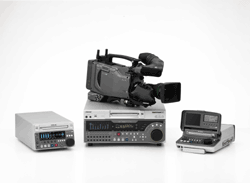 New York, NY - Sony Professional Products will show two new camcorders and three decks, part of a new professional optical disc system to be available in the fall, as part of its NAB exhibit, the company announced.
The optical system (pictured) records both high-resolution original, and lower-resolution versions called proxies, video and audio. From the camcorder or a battery-operated mobile deck, videographers will be able to transfer the proxy information to laptop editors or back to the studio at up to 30 times faster-than-real-time. Video can be transferred as high-resolution footage or a data file over IP networks, the manufacturer describes.
The optical disc system offers choice of recording video with the DVCAM codec at 25 megabits per second or the MPEG IMX codec at 30, 40 or 50 megabits per second. Optical decks will accept both formats and offer the full range of analog A/V, digital A/V and information technology (IT) standards, including compatibility with i.LINK (IEEE 1394) and Ethernet interfaces.
The optical media consists of a five-inch (12 centimeter) re-writable disc in a protective cartridge. Blue laser technology for recording and playback is used.
The new system offers familiar optical disc benefits, including split-second random access, no physical head contact during record/playback, and cost efficiency associated with the media. A single disc holds 90 minutes of DVCAM material or 45 minutes of MPEG IMX material recorded at 50 Mbps, 55 minutes at 40 Mbps, and 75 minutes at 30 Mbps.
Sony's two optical disc camcorders and three decks support both the i.LINK and Ethernet interfaces for transferring assets as Material Exchange Format (MXF) files.
The two camcorders are able to capture high-quality pictures with 2/3-inch EX HAD image sensors and 12-bit analog-to-digital converters. Features include loop/interval recording on a built-in cache memory; Ethernet or wireless LAN interfaces through optional PC-CARD adaptors, and a 2.5-inch (viewable area, measured diagonally) LCD monitor for playback, marking good shots and re-sequencing clips. The camcorders can output low-resolution proxy video at up to 30 times faster-than-real-time.
The battery-powered mobile deck plays back DVCAM and MPEG IMX recordings and displays them on the built-in LCD monitor. The deck supports up to 30 times faster-than-real-time transfer of low-resolution proxy video over i.LINK and Ethernet interfaces, in addition to MXF file transfers over a 100-BaseT network connection.
The compact, NLE companion deck, a half-rack feeding/recording machine for non-linear editing, supports up to five times faster-than-real-time transfer of full-resolution DVCAM audio and video and up to 50 times real-time transfer of low-resolution proxy audio and video. Transfer speeds for MPEG 4:2:2 video range from four times real-time for MPEG 30Mbps to two-and-a-half-times real-time for MPEG 50Mbps.
The studio deck, which is a standard editing deck that offers both DVCAM and MPEG IMX recording and playback, provides a full complement of analog A/V, digital A/V and IT interfaces, including the i.LINK interface and Gigabit Ethernet port. The studio deck supports up to five times faster-than-real-time transfer of full-resolution DVCAM audio and video and up to 50 times real-time transfer of low-resolution proxy audio and video. Transfer speeds for MPEG 4:2:2 video range from four times real-time for MPEG 30Mbps to two-and-a-half-times real-time for MPEG 50Mbps. The studio deck works with both nonlinear and linear editing systems.
For more information, visit
www.sony.com
# # #
For a listing of all the WEVA News Stories...
Click Here |



